Showing posts with label Acadian Expulsion. Show all posts

Thursday, December 12, 2013

Acadian Expulsion II: Exile brings my 5th great grandparents together


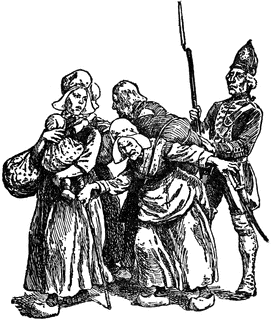
It was a clear fall day in Port Royal, L’Acadie (now Annapolis Royal, Nova Scotia) when Anne Doucet age five , my 5th great grandmother, stood on the deck of the ship that would take her, her parents Jean Doucet and Anne Bourg and her two younger siblings Joseph three and Jean Baptiste less than one year old, away from all that was dear and familiar to them. Did she stand tall straining to see over the rail as their world went up in smoke? Did she tearfully cling to her mother’s skirts as her parents held her younger siblings? Little did she know that day what more changes would come in her young life. Oddly enough if her family had not been exiled she probably would never have met her future husband Charles Dupuis, age 9, who was being deported from Grand Pre the same year.  Exiles they would be brought together by fate in the British colony of Connecticut. There they would exchange wedding vows about 8 years from now.

The ship, possibly the Experiment, was bound for New York under a British order expelling over 6,000 Acadians from their home which they had occupied for over 150 years. They were being scattered all over the British colonies in North America and the Antilles. For some reason this ship stopped in St. Christophe, an island in the Antilles held by the British. There her father Jean would die of the chicken pox at age about 30. Her mother would continue with her small children to New York and eventually Connecticut where she met and married another deportee, Joseph Herbert who  had lost his spouse Madeleine Dupuis, sister of Charles Dupuis my 4th great grandfather. Anne is listed with him there in 1763 and their combined family of nine children. By the time they would be free to leave exile Joseph Herbert and wife Anne would have five more children. Did Charles and Anne meet when Joseph and her mother married and there were relatives of his first wife in attendance? Charles Dupuis, an orphan, was also living in Connecticut with his brother Simon-Pierre and his family. Connecticut was more prepared and hospitable to the deportees and the legislature made provisions for the Acadians of whom 700 eventually wound up on their shore.

They were civilians caught up in Le Grand Derangement – the Great Expulsion of neutral Acadians during what is called in North America, the French and Indian War and in Europe, the Seven Years War. They had lived under British rule since before Anne and her parents were born. (See my blog Acadian Expulsion I for explanation of the reasons for the expulsion and the story of Charles and his 10 siblings)  
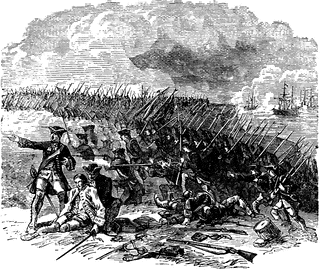
The British victory in the  battle on the Plains of Abraham, near Quebec City, in 1759 and the treaty  of 1763 gave the refugees from L’Acadie another hard choice. There was little possibility of returning to their farms confiscated and given to British settlers. A few stayed in the colony to which they had been deported but most sought to find more culturally congenial places to live. Those deported to England where conditions were harsh asked to be sent to France. There was a promise of land but the French King failed them and most left again to immigrate to a new territory. Louisiana had passed from French to Spanish rule by 1762 and the Spanish were welcoming to new settlers especially Catholics. The first Acadians arrived in Louisiana in April 1764 and a flood would follow them as news got back about the area. Some who went to the Caribbean to the island of Dominique, French territory eventually wound up in Louisiana.

Charles and Anne exchanged their wedding vows privately before two witnesses around July of 1768 in Connecticut, since there was no priest present to witness their marriage. Perhaps they  were already preparing to go back together to Canada. Daughter Marie Anne would be the only of their 11 children born in Connecticut. Nine months later, in the parish church of Laprairie in the Richelieu valley south of Montreal, they renewed those vows in April 1769. Charles was the only one of his siblings who would return to Canada – perhaps because of his marriage to Anne as most of the Herberts would return to this area as well as her mother and step-father Joseph Herbert and her half siblings. Only Anne’s brother Joseph appears to have decided to follow other Acadians south, perhaps via the Isle of Dominique to finally settle in Louisiana. In 1772 at age 20 he marries Anne Landry, a fellow Acadian,  in St. Martinsville, Louisiana and they settle and raise a family in Opelousas where he dies in 1803.  Jean Baptiste disappears from the records and may have died during the expulsion or while in Connecticut. In a list of Connecticut residents in 1763 Joseph Herbert and second wife Anne Bourg are listed with nine children only, Jean Baptiste would have made 10 if he was still alive.

Anne Doucet’s family now merged with that of Joseph Herbert decided to return to French speaking lower Canada (now under British rule) and settle in the Richelieu valley and join her daughter and her husband. There was no hope of returning to L'Acadie and reclaiming confiscated lands. They probably were homesick for their own language, customs and religious tradition. They arrived in 1774 when her mother’s 1762 second marriage in Connecticut was blessed in the church of Laprairie.  They brought five small children born in Connecticut between 1763 and 1773 which may account for their longer stay in Connecticut. Did tensions between the American and their British rulers influence their move?Joseph died six years after they had their marriage blessed and recorded in the parish records. Members of Joseph’s family including his father had settled in Laprairie area after 1763.

Charles Dupuis and Anne Doucet would have  10 more children in Lacadie and in Laprairie where they moved in the 1780's. Anne died 10 days after giving birth to their youngest child in 1790 and Charles in 1798. Both are buried in Lacadie. They never saw Salome their  granddaughter my 2nd great grandmother born there to their son Antoine and his wife Josephte Montminy in 1822.


Monday, November 25, 2013

Acadian Explusion: a family scattered


File:A View of the Plundering and Burning of the City of Grymross, by Thomas Davies, 1758.JPG
Contemporary painting of another Acadian town being burnt - Thomas Davies 1758*

On a summer day in 1755 my 4th great grandfather Charles Dupuis, age 9 watched from shipboard as everything he knew receded over the horizon. He, with 10 of his brothers and sisters, their spouses, uncles, aunts and cousins watched in horror as British soldiers set fire to their farm houses and barns. He left behind the graves of his parents Antoine and Marie Josephte Dugas who died when he was only a year old. He would be the only one of his family who would return to what had been French territory. Before that he would be a refugee in the British colonies of North America.

My great grandmother Adeline Raymond pictured on the right,  was descended from many of the original settlers of L'Acadie. (modern Nova Scotia)  Her mother was listed as "Sally Wells" on US records. I knew she was French and eventually discovered that her real name was Salome Dupuis, daughter of Antoine Dupuis resident of Lacadie, a small town south of Montreal in the Richelieu valley. Her paternal grandparents Charles Dupuis and Anne Doucet were both born in L' Acadie - he is Grand Pre in 1746 and she in Port Royal around 1750. Hence both as children would have been witnesses to the expulsions and emigrations from Acadie which began in the late 1740's and escalated 1755-1762. It is unlikely that Salome knew her grandparents as both died before she was born. Did she learn of the exodus from stories passed down in her family? If so did she pass them on to Adelaide?

The fate of the children of Antoine Dupuis and Marie Josephe Dugas, parents of Charles, gives a sample of the various places of deportation and emigration experienced by families in L’Acadie. Antoine and Marie both died in Grand Pre in 1747 right before the Acadian Expulsion known as L’Grand Derangement. My ancestor Charles, twin brothers Joseph and Jean Baptiste and sister Euphrosine were all under 10 when the parents died and likely were taken into the homes of older married brothers and sisters.

Charles Dupuis and Anne Doucet had lived under British rule all their lives.  Britain ruled L'Acadie since 1713, before both of their births. Their ancestors had settled this area in the early 17th century.  After the British takeover initially their families' lives on their prosperous farms had continued as before. The "Great Meadow" had rich farmland that had been reclaimed from the sea by a system of dikes. In 1730 the Acadians swore an oath of allegiance to the British on condition they would not have to fight the French or their Native allies. But toward the end of the 1740's there was unrest in the area due to British insistence on an unconditional oath of allegiance. Wars being fought far away in Europe had repercussions on the land of L'Acadie. Unrest spread and between 1749-1755 active armed resistance to British rule spread throughout the area.

The 11 living Dupuis children (which included two sets of twins) their spouses and children were scattered through the British colonies and England. The names of Charles' brothers, uncles, cousins, brothers-in-law all appear on the list of men scheduled for deportation in 1755. Some of these colonies were hospitable to the refugees but others resented having these families thrust upon them - French speaking and Catholics in an English speaking and Protestant colony. Those who went to England fared worse since they were regarded as enemy combatants and prisoners of war. Three of Charles siblings were sent to England: Francoise Osite Dupuis, her husband Honore Daigle, their children, his brother Jean Baptiste age 10, and eldest sister Marie Josephe Dupuis with her children and  husband Pierre Theriot. Of these Francoise died in England as well as brother -in-law Pierre.

Older brother Antoine Dupuis, wife Marguerite Boudrot and family were sent to New York. Simon-Pierre, wife Marie LeBlanc and children may also have originally been sent to New York but made their way to Connecticut with widowed sister Marguerite Dupuis Boudrot, Charles and sister Euphrosine. His  sister Marie Anne and husband Michel Boudrot were deported to Portabac in Maryland Joseph Herbert and wife Madeliene Dupuis were sent with their teenage children to an unknown British colony perhaps New York with Jean Baptiste's twin Joseph.  Later, after Madeliene's death,  they wind up in Connecticut where he will meet and marry my 5th great grandmother Anne Bourg widow of Jean Doucet, parents of Anne Doucet who would later marry Charles Dupuis. (but that is a story for another blog entry)

When the war between France and Britian ended with a treaty in 1763 the Acadian exiles were free to move to more congenial locations. Between that date and 1767 siblings and their families went to the French speaking island of Dominique (present day Haiti) in the Carribean. Antoine and wife  baptized their children born in New England in Mirebas. Both  parents  died and were buried in Mirebas. Some of their children would continue on to Louisiana. A Spanish colony in 1765 it was especially hospitable to Catholic immigrants seeing them as a bulwark against the British. Acadians who stayed in Dominique were forced to more again during the Haitian Revolt and many moved to  Louisiana which was once again French and back to the former British colonies now the United States.  Marie Dupuis Boudrot and family  brother Joseph, Marguerite Dupuis Boudrot and children,  also sought refuge in Louisiana. Marie Anne Dupuis widow of Michael Boudrot deported to Portabac Maryland went with her family to Louisiana. In 1802 with the Louisana purchase that territory became part of the expanding United States.

Those in England went to France: eldest sister Marguerite Dupuis Theriot  now widowed, her children and Jean Baptiste age 21. In 1767 they were among 78 Acadian families living on the island Belle-Ile-en-Mer off the coast of Brittany. It is from an affidavit sworn by her that much of the information about the family migrations is known. Those in France were often disappointed because the French government did not live up to promises of land and support for the refugees. Some Theriot children who went to France eventually wound up returning to the New World and settling in Louisiana. Jean Baptiste died, unmarried in France in 1783.

 Of the 11 living children of Antoine and Marie Josephte only my ancestor Charles found his way back north after being deported to Connecticut. While in Connecticut he met and married Anne Doucet (her family story will be another blog entry)  In 1769 he came back to former French territory with his new wife and some of her relatives,  to have their 1768 marriage blessed in the newly founded town of Lacadie, Quebec. This town was founded by Acadian refugees and its church Ste Margaret of Blainfindie has the records of the many descendants of Charles including my 3rd great grandmother Salome Dupuis.

This summary of the fate of Antoine Dupuis and Marie Josephte Dugas' children is a microcosm of the Acadian Expulsion - to the British  colonies, to France, England and the French Caribbean islands and eventually migration back to French Canada and Louisiana.

* http://cybermuse.gallery.ca/cybermuse/search/artwork_e.jsp?mkey=3755