Friday, June 28, 2013

Where in the world do they come from? Following breadcrumbs.

My Leary and Callahan side is from Rathmore, Co. Kerry (and probably immigrated there in the 17th century from Cork). I can pinpoint the townland upon which they farmed in 1850. My Shea and Farrell line is from Limerick and lived in Mungret, near Limerick City before immigration. My Corbett and Grace line is from Turkstown, Co. Kilkenny. Thanks to finding their origen in Ireland I have been able to visit each place and in two cases stand on the land on which they lived. 

However my Bresnahan and Fleming side has eluded me. Unlike all three of the other lines there is no family oral tradition as to where in Ireland they lived. No vital record or obituary has been found that pinpoints the county in Ireland. So I started following the few bread crumbs I could see based on available records and a blanket search for other families with this surname in the immediate area.

Bresnahan is a traditional Kerry name. The names Bresnahan, Brosnan and Bresnan in Ireland are derived from the native Gaelic O'Brosnachain sept that was located in County Kerry in the South of the country. The name is most likely taken from the small townland of Brosna that is located in that region. A search of Irish parish records for the area - on line at www.irishgenealogy.ie has loads of Bresnahan/Brosnahan and other variants but none that fit my family. Sorting them out has gained me quite a collection of Bresnahans in this area of New Hampshire.Our family has used Bresnahan but others use Brosnahan, Brosnan.

Castleisland Kerry
Searching through the Bresnahans in Manchester and Concord NH where my ancestors settled opens up more questions than answers. James Leary, my great grandfather married Julia Bresnahan in St. Ann's parish, Manchester, NH in 1863. That points to her residence in that city since the custom was to marry in the bride's church.

Mill workers apartments near Amoskeag mill (ahead)
A search for Bresnahan families in Manchester yielded many, some of which may be related. The best match for mine was Julia, 21with her mother Margaret Fleming 62, sister Honora 16 and two other perhaps related Bresnahan's Margaret  15, Patrick 17 and a Honora Dillon 19  in the 1860 census.  They all appear to be mill workers. A Margaret is listed in 1855/6 in the city directory and the family appears to have arrived (according to different census) between 1850-1855. By the date of this census Andrew Bresnahan, brother to Julia and Honora had already married Mary Leary sister of her future husband James. Perhaps that was how Julia and James met. Sadly I have been unable to find a record for Andrew, his wife Mary and son Corneilius b. 1856 in the 1860 census anywhere in the US. There is no death record for him in New Hampshire or neighboring states. Mary and her son disappear until 1870 when she is working as a servant in Concord with the woman who will marry the Patrick listed in this census. Her son is being cared for by his aunt and uncle James and Julia Leary.

From other records I was able to learn that the Margaret who lives with them in 1860 is the child of a John Bresnahan and a Johannah Fleming, Patrick is the son of a John Bresnahan and a Mary Fleming. I was led to these records by the obituary of Andrew's son Corneilius Bresnahan in 1903.  Margaret is listed as a relative of Corneilius when she attends his funeral in 1903 as is her half sister Julia. Both are listed under their married names and the marriage record of each showed they were Bresnahans. That led to a John Bresnahan who might be a brother to my great great grandfather Corneilius.

John Bresnahan b. 1810 lived in  Manchester NH with 1st  wife Johannah Fleming. He is father of Margaret Bresnahan who lived with our family in 1860 and of her half sister Julia Bresnahan with second wife Mary Sullivan Cashman. Margaret married  Peter Haggerty and Julia married to  John F. Cahill and both attended the funeral of Corneilius Bresnahan and are listed in obituary as relatives. Members of the Leary / Bresnahan family attended funerals from their family also and are identified as relatives.  Of course he may also be connected to our family via his wife, a Fleming like Margaret Fleming.
2nd from top: Record of Leary/Bresnahan baptism with John Bresnahan as sponsor 1870
Since the Irish usually ask relatives to be godparents and marriage witnesses I explored a connection with the only Bresnahan family in Concord in the mid 19th century. I discovered that John Bresnahan whose first wife was Mary Fleming appears also to be the father of Patrick, the young man who lived with my family in Manchester in 1860. John Bresnahan is the godfather of my grandfather James T. Leary son of James and Julia. He is a good candidate to be related to our family, both from the association as a godfather and the surname of his first wife. He remarried twice after his wives died, to Johannah Coughlin with whom he had a second family and late in life to Mary O'Hara. Born around 1800 he is also of the right age to be a brother to my great great grandfather Corneilius, husband of Margaret Fleming. John's parents are Dennis Bresnahan and Mary Broderick.


Trying to research this John Bresnahan's orgin in Ireland was confusing. He might be from Cork (on his son's grave in Wolfboro, NH that is given as place of origen) or  Limerick. A Callaghan McCarthy is living with John in 1860. Callaghan  (from other sources and another researcher) is from Rathkeale in Limerick and with him is  his wife Margaret Bresnahan. Two other Bresnahan women live there Kate and Catherine both single and listed as aunts in the McCarthy family.  Are they from Limerick or from Kerry or from Cork????


The majority of the  Bresnahan families in Manchester NH are from Kerry especially the area around Castleisland and Tralee. However a search of the Kerry parish records, which are extant for dates  of the family births did not yield records for Julia or her sister Honora that fit.  From the map above it can be seen that Castleisland is very close to the border of Limerick and to that of Cork.

Cemetary records for Old St. Joseph cemetary in Manchester have many Bresnahan burials. Unfortunately no stone has the name of Margaret Fleming Bresnahan on it although she is most likely buried there. There is an old Bresnahan burial plot with multiple interments but no individual markers. 

So the mystery remains - where in Ireland did my Bresnahan great great grandparents Cornelius Bresnahan and wife Margaret Fleming originate?

Friday, June 7, 2013

Mystery Mothers

Every genealogist deals with brick walls. Women's history sometimes is daunting as maiden names are overlooked in many records. At a certain point it is hard to go further back when all a person has is a first name. Some of my mystery mothers are:

Josephte Abenlak (Allerlock) 1750/60- before 1805 is my 4th great grandmother. All I know of her is her husband's name Jean Gray and that they were married in Albany. The marriage date is unknown. Both she and her husband may have been Native American. There was a settlement of Abenaki natives in Scaghticook near Albany during the upheavals of the French and Indian Wars. Did she live there? Her surname may be a corruption of Abenlak. She is my father's 2nd great grandmother. A strong family oral tradition has this line the source of native ancestry. Records are scarce in Albany for this period and no Catholic records exist. Many Mohawk Indians appear in the Dutch Reformed records but few are present and named in Anglican records. Indian baptisms and weddings are often noted generically i.e. baptised 4 Indian children and married 3 couples. Right when their daughter would have been born - 1780-86 records do not exist because of the upheaval after the American Revolution.

 Their daughter Marguerite Gray married Paul Desmarais dit Beaulac in 1805 in St. Charles, a town in the Richelieu valley south of Montreal. (See the record above - hard to decipher her mother's last name)  Her  father is listed as deceased. Paul, a widower, is listed  as from the "parish of the Hurons called St. Jean Baptiste". This is a puzzling allusion since St. Jean Baptiste would more likely be the parish of the Abenakis.The family lived in Swanton Vt. from 1810-1814 and 1823-25 based on birth places of children. They are  not in 1810 or 1820 US census. This family moved around quite a bit - with  children born in Canada and Vermont. Marguerite is dead by 1839. Her husband probably dies in New York state where is is living with a daughter and her family in 1850 census.
Their daughter, Marguerite Desmarais dite Beaulac, married Jean Baptiste Chicoine  in 1822  in Swanton, VT an area where the Abenaki tribe settled. Although Jean Baptiste b. 1798 is clearly identified as son of his father the connection with his mother is not verified by any record. His father Jean Baptiste Chicoine married Archange Valade in 1798 and their first son is Louis born 1799. They baptized several children in Montreal between 1799 and 1810 but no Jean Baptiste. So his mother may be another mystery woman!
Rose Bonin 1800-after 1851 is from St. Elizabeth, Joliette, Quebec. She is my 3rd great grandmother in my great grandfather Joseph Moreau dit Desrosiers line.  She is raised by Louis Bonin and wife Therese Goulet. Her wedding record records the relationship to Louis as that of a ward, foster child or adopted. using Bonin as her surname but on the baptism record of her first child her surname is left blank. Was she native American? In this area there are several records of native children - mostly boys, returned by a fur trapper father to be raised there. Was she related to Louis or Therese, an orphaned niece or cousin or a foundling? Several Roses and Rosalies with the surname "unknown" are also in the Berthier registers at the beginning of the 19th century. She married Jean Baptiste Belhumeur dit Blosse in 1824 - having at least 14 children up to 1848. Less than half of these children survived past age 10. She and her husband are listed in the 1851 Canadian census in St. Felix of Valois parish, Berthier Co.  Her birthplace is indicated as French Canada. 

Catherine Degres or Depre 1664-1758 my 7th great grandmother, was a Native American from the Gaspe pennisula, possibly of the Mic'maq tribe. She married Etienne Girard at Mount St. Louis  around 1705. He is also somewhat of a mystery - with no parents known and the nickname of "Le Breton" perhaps a clue to his birth in Brittany. Their first daughter Marie Catherine was born there in 1706. Neither Catherine nor Etienne are in the 1699 or 1700 census of the area. The couple had 15 children some born at Mount Louis and others in Anciene Lorette (a Huron village)  near Quebec city where they later settled. Over 1/2 of these children did not survive past age 5. The family traveled to Quebec City to record baptisms performed by lay officials in Mount Louis. It is from these records that we know Catherine was a Native American. The priest baptizing their daughter Marie Louise identifies her as Catherine "d'un nation sauvage" and her daughter as Metisse (mixed blood) Their daughter Marie Francoise is my grandfather Paul Marcel Chicoine's  many times great grandmother.
Mount St. Louis, Gaspe, fishermen


Catherine Pillard or Pallet 1646-after 1688 was not a mystery before DNA. She was listed as a Fille du Roi from La Rochelle and her 1665 wedding record to Jean Charron clearly gives her parish and parents Pierre Pillard and Marguerite Moulinet. Her city of origin is also noted on the occasion of her second marriage many years later. On the basis of maternal mtDNA descendants of her daughters  carry genes linked to Amerindian lines of Siberian. This DNA is passed directly from mother to daughter. This raised questions and started a controversy over her actual origin - was she the daughter of a Huron chief named Catherine baptized in Montreal in 1646 rather than the Catherine originating in La Rochelle?  If so why would she be misrepresented on her marriage record? Was she an Indian woman or the daughter of one, brought by explorers to France who then returned to New France?  French explorers had been to New France since the mid 16th century and  had brought back natives to their homeland. Some scholars feel that French fishermen were aware of the area from the 15th century. If so her mother or grandmother would be the person with Amerindian ancestry. Or is this a genetic fluke, DNA passed down in France from previous invasions centuries ago?

A detailed discussion can be found on the website:
http://www.charron-ducharme.org/index.php/en/catherine-pillard-en/87-catherine-pillard-s-origin

Marguerite Thomas (1635-1695) The foreign bride
 
Marguerite Thomas was from Stavelot, Liège, in what is now Belgium, daughter of Jean Thomas and Marguerite Fredrey and about 21 years old when she arrived in Canada in the summer of 1655. Her hometown was not French but part of the Holy Roman Empire under the authority of the abbot of Stavelot. It was located in the area called Southern Netherlands ruled by Spain.  She was among a number of marriageable women who came to New France between 1634 and 1663 with the idea of finding a husband. (unlike the government sponsored Filles du Roi they did not receive government assistance and came alone, with family members or in a small group)  What motivated her to come to New France?  Whatever did,  she quickly found herself a spouse. Jean-Pierre Trudel was a cotton weaver from the parish of Notre-Dame in Parfindeval, La Chèverie, Orne (Perche), Normandy.  In November of 1655, they were married in Chateau Richer, QC.

Trudel had arrived in Canada as a bachelor in 1652 from the Perche area of Normandy, and is considered part of the Percheron Immigration.  First mention of him is in Québec is 11-13-1655 at his marriage contract.  The young family lived in Québec, and in 1657, established themselves at l'Ange-Gardien on land acquired from M. LeGardeur de Repentigny. Their daughter Marie Madeliene Trudel one of their nine children,  is my 7th great grandmother in my Chicoine ancestry.

Tuesday, May 28, 2013

Vikings and Visigoths: the DNA mystery

I am often struck by how we are the results of random choices by our ancestors, decisions to move, to immigrate, to live one place rather than another. My parents might never have met if my grandfather had not lost his business during the 1920's and moved from one side of Vermont to another.  My father would not have been living there if his parents had not decided to finally settle permanently in Vermont. His family had a history of almost 100 years of going back and forth to Canada. He was born in Canada. Recently I had my DNA tested for ethnic origin, thinking it might answer some questions. Like many genealogical answers it only provided  more questions.

My limited understanding of how DNA works is that you get pieces from both parents: 1/2 from each. What pieces they pass along may differ. My profile is came out as 58% British Isles, 19% Scandinavian, 17% Southern European and 6% other.  However my sibling's is 78% Scandinavian, 19% Southern European and 3% other. With an Irish mother it does seem strange that there is no British Isles DNA in her profile.  Looking at the migration patterns of the Celts below it is also possible that they may have contributed to the Southern European DNA that both of us have. Viking DNA is distributed widely over Europe: Ireland and France would both have Scandinavian DNA. Irish legendary migration histories have the invaders coming to the island through what is now the Iberian peninsula.


The migration of the Celtic tribes across Europe reached the Irish isle in the period from 2000-300 B.C. These peoples probably carried DNA from what is now Austria, France, and Spain. Ireland is unique in that it was never invaded or conquered by the Romans who occupied what is today modern Britain and Scotland.
File:Wikinger.jpgI was expecting my Irish mother to contribute British Isles and Scandinavian DNA. The Vikings founded the cities of Ireland when they were tired of plundering and realized they could make a bigger profit by becoming merchant traders.  These "trading posts" developed into the cities of Dublin, Waterford, Limerick, Cork and others. I  suspected there was some Welsh ancestry  and one line is Norman Irish which could either bring the Scandinavian or British Isles genes.


From my Dad obviously I got some British Isles, Scandinavian and Southern European - he was French Canadian and part Native American which might account for the 6% other. I wondered why it did not reflect central European DNA - which covers France. So I started to look at the history. Given the immigration statistics on the areas where his ancestors originated I found the Celts and Vikings again. Normandy and the area around Paris were Celtic strongholds. Paris, a Roman city was taken over by Frankish tribal peoples and attacked by the Vikings. There were many immigrants from La Rochelle and surrounding areas passed back and forth in the middle ages between English and French control.  More British DNA perhaps? That area was also settled by the Romans - more southern European DNA? What I didn't expect was the Visigoths. 

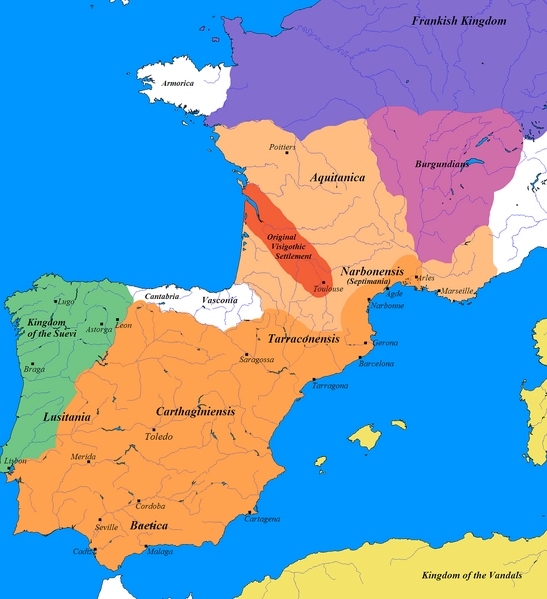
File:Visigothic Kingdom.pngThe Visigoths were a "barbarian" people who had invaded Italy and Rome in the late 4th and early 5th century. They migrated through the Mediterranean countries and became sufficiently powerful to fight a successful war with the Romans whom they defeated in 378. A treaty allowed them to fight on the side of Rome until conflict broke out and they sacked Rome in 410. They swept into the power vacuum left by the declining Roman empire in the 5th century. They converted to Christianity and became the civil authority in the structures of the empire left behind. Their capital was at Toulouse. (We have a double connection with Toulouse through my great grandmothers Adelaide and Virginia Raymond dite Toulouse)  The settlements in France were largely in the south west along the Garonne River. The Visigoth kingdom in Gaul was defeated by Clovis in 507. The main territory remained  Spain and Portugal, at least until the 8th century when there was a Muslim invasion. They may account for the southern European DNA.

DNA opens interesting windows into the past. Its bits and pieces have been sorted and passed on from parents to children for centuries. 

Monday, May 13, 2013

Founding Mothers: La Fille du Roi

Working with the genealogies of the mothers on my family tree in honor of Mothers' Day I realized all the fascinating women that are in my own bloodline. This blog entry will focus on one of the founding mothers - the original female  immigrant of the Chicoine line and her story. She was my 7th great grandmother and came to New France as an imported bride at age 18.

St. Eustache church Paris
Magdelaine Chretien 1652-1709 was born in Paris, France and baptized in the parish of St. Eustache. The church dates from the 16th century and was next to the large city market Les Halles. Her parents were Toussaint Chretien and Francoise Bertaut.  She had some education - at least enough to sign her name on her wedding record. She was a Fille du Roi, (Daughter of the King)  one of about 120  women assisted immigrants  that year. They were part of a government funded program to provide French wives for the many single Frenchmen living in the colony of New France. Over a ten year period about 770 women came this way to New France. (There are at least 40 other Filles du Roi in our family tree)

Magdelaine   left a city of perhaps 500,000 inhabitants, with beautiful and historic buildings, commerce and culture. Moliere was premiering a play in her neighborhood that year. The Filles from Paris traveled by river boat to the nearby port of Dieppe to board their ship, aptly named  "La Nouvelle France". The ship probably left in late spring, around mid May. The 53 girls from Paris  were joined by the 22+ young women from Normandy. The ship then continued to  La Rochelle where the rest of the passengers joined them.

The ocean voyage probably took about two months, although some travelers mention 11 weeks depending on the weather. Conditions were crowded and unsanitary. If the passengers were lucky they got fair weather and could get fresh air on deck. The women had ample time to get to know one another and there are many connections between them. Besides Magdelaine, two others: Marguerite Moreau and Catherine Fourier are ancestors of my grandmother Ida Emma Desrosiers who would marry Paul Chicoine, Magdelaine's descendant. Marguerite Moreau may have joined the vessel in La Rochelle or Dieppe since she lived in Orleans. She would become my 8th great grandmother. A descendant of hers,  Marguerite Ricard would be the mother of  my grandfather Joseph Moreau dit Desrosiers. (From a different Moreau line) Catherine Fourier who also appears in the  Moreau line was, like Magdelaine, from Paris. She was married at least 3 times - her first to Mathurin Mercardier on October 15 was witnessed by Magdelaine Chretien and Magdelaine Therese Salle. When, a young widow with a child, she married Pierre Bosquet in 1672 Magdelaine Salle was again a witness. A 7th great grand aunt, Marguerite Deshayes from Rouen, is coming to join her sister Marie, my 7th great grandmother. Marie arrived in 1668. and married Adrien Betourne.  Marguerite's eldest niece would marry Magdelaine's eldest son Pierre Chicoine.

Magdelaine age 18, along with Marie Chretien, 15 who may have been a cousin, left for the colony in May 1670.  Marie also lived in Paris but on the left bank in the 5th arrondissment in the parish of St.Suplice. Magdelaine Therese Salle  was from the same parish as Marie and would attend Magdelaine's wedding as she would hers. Also from St. Suplice was Catherine Fourier my 8th great grandmother ancestor of my grandmother Ida Emma Desrosiers.  The pastor of the parish of St.Suplice recruited about 68 women and 12 from his parish were on board the Nouvelle France in 1670. 

Many of the girls on the voyage were orphans but Magdelaine Chretien's parents were alive, based on evidence from her marriage record. Marie's father was deceased. Magdelaine Therese Salle's parents were living, her father was a master painter for the King.  Most of the Filles were young and single but at least one widow traveled on this trip Francoise Goubilleau who traveled with her son  Pierre Maguet. There is a sprinkling of women from  bourgeois families and daughters of military and court officials on the passenger list who may have carried additional funds for their dowry. The King's program provided most of the women with a grant of at least fifty French pounds and a trunk with some basic clothing and sewing supplies.

The towers of La Rochelle .

La Rochelle from ship in harbor
La Rochelle was a good size town with impressive towers that protected the harbor and many churches and large buildings. Ruled at times in the middle ages by England it was now the center of trade with New France. It had survived some bitter religious wars and there were Protestant (Reformed) churches in the city. Religious strife between Catholics and Protestant led many Reformed church members to immigrate. Although New France was closed to all but Catholics there were some  who managed to immigrate there by adopting the Catholic faith.
View looking back at the town of La Rochelle

Paving stones from New France
So many ships went from this harbor to New France that some streets were paved with the ballast stone of those returning from Canada.  The last glimpse of their homeland for Magdelaine and her companions was the city of La Rochelle. Most would never see their homeland again. However for all of the girls this adventure gave them a financial security and independence that they could not have hoped for in their homeland. At least one girl on this trip, Magdelaine Therese Salle, would only stay in New France for 10 years and would return. Her husband and children would join her in Paris where she would die.

Summer provided a smoother and safer voyage, winter traveling ran the risk of rough stormy crossings. It was possible to encounter ice bergs at anytime.  Extremes of weather and violent thunderstorms are described by contemporary travelers.

When she arrived in New France July 31st the ship stopped in Quebec city, a large settlement with about 3,000 inhabitants. It had a  few stone dwellings, a church the size of village ones in France and the wilderness pressing in around it. Marguerite Moreau and some of the others disembarked here. She would be married in a month to Andre Morin from Poitiers. As they continued down to Montreal,  Magdelaine would have seen farms of the "long lot" type which lined the banks of the St. Lawrence. Their narrow and long fields that allowed families to live near each other for protection and communication with the river.  When she arrived in Montreal it must have been a big contrast with the city of Paris. It had about 500 with perhaps 50 dwellings mostly of wood.  

Notre Dame des Victoires near port
When they docked in Montreal the Filles du Roi were lodged with the nuns of St. Marguerite Bourgeoys in Montreal or in Maison Saint Gabriel outside of the city. The current church of Notre Dame des Victoires, near where they landed  was a small chapel at the time and the facing stone house may have housed some of the girls. Marguerite is credited with inventing the title: Fille du Roi to distinguish between immigrants who came with government assistance and those who came on their own. The girls ranged in age from 13-18 or more. The Sisters took on the task of educating these girls, many from urban areas, and some very young, in domestic arts and the skills they would need to survive as a frontier wife.


After the Filles du Roi arrived the nuns put out a sign advertising "girls to marry" and eligible men cleaned up, got dressed up and came to be interviewed. The girls were able to ask pertinent questions such as whether the young man owned a cow or chickens, had a house with a floor and was clean in his habits.  Men looked for robust women who would survive the harsh weather and produce many children. The bachelors were eager since every year a man remained single after 20 he faced the "bachelor tax".
House where women stayed in Montreal


Magdelaine had made a friend on the voyage, Magdeleine Therese Salle. She  attended her wedding Sept. 30, signing the register. A few weeks later her friend attended hers and signed. Some time between her arrival in Montreal in mid August she met with and liked Pierre Chicoine age 28 born in a small town near Poitiers,  who had arrived in the colony a few years before her. He may  also have been an assisted immigrant - a person whose passage was paid by a landholder in return for a number of years of service. He appears in the 1666 Montreal census as a domestic, working for Mathurin Langevin, one of the original settlers of Montreal. By the time he met his future bride he was living in Longueil on the seigneury or fief of the LeMoyne family. Charles LeMoyne, age about 14, son of the seigneur would be one of the witnesses to the marriage of Pierre and Magdelaine. (see below). On the same day as Pierre and Magdelaine another girl, from the ship, Anne Foubert was married in Notre Dame church (a much smaller chapel than the current grand cathedral). Her groom Pierre Boisseau also worked for the LeMoyne's. Their two families would remain connected. Their daughter Marie Boisseau would later marry Magdelaine and Pierre's son Paul.


She and Pierre remained in the Montreal area where many of their children were baptized.  By the census of 1681 they appear the town of Vercheres east of Montreal. They own a gun and 7 head of cattle and have 10 arpents of land. Their eldest son Pierre settled on his own fief called Bellevue in Vercheres where today there are many Chicoine descendants.  They had 7 girls and 3 boys. Most of modern day US Chicoines are descended from sons Pierre and Paul. (Their other son Francis married but had no children) Magdelaine survived her husband and remarried in 1702. Unlike her friend Magdelaine Therese Salle she would stay in New France and die there 7 years later.

In 1826 Jean Baptiste Chicoine, 5th generation descendant of Pierre and Magdelaine, who had married in Swanton, Vermont,  traveled back to have his daughter Marie Emilie baptized in the parish church of Vercheres. His aunt Marie Emilie Chicoine and her husband Antoine Gosselin served as godparents.

Tuesday, May 7, 2013

Chercher la femme! French mothers and grandmothers

On this week before Mothers day I am looking at the matrilineal ancestry in my family tree. On my paternal grandmother's side I can go all the way back to 16th century France in the area around LaRochelle. 

Ida Emma Desrosiers (Moreau dite Desrosiers) 1873-1924 was born in Vermont, a second generation American whose grandparents immigrated from French Canada. In the only fuzzy  picture I have of her circa 1890 she is living with her husband in Canada and expecting their first child. She would have 9 pregnancies and 7 children would survive. She and her husband Paul Marcel Chicoine would move back and forth across the US border until finally settling in Highgate, Vermont in 1906.

Adelaide Raymond (Raymond dite Toulouse) 1852-1916 was born in Highgate, Vermont. Her cousin Virginia Raymond was the grandmother of Ida Emma's spouse Paul Chicoine. She married Joseph Desrosiers (Moreau dit Desrosiers) in 1870. She had at least 12 children between then and 1895. 9 girls and 3 boys.She lived all of her life in the small Vermont town of Highgate in a section called "Frenchtown" because of the number of French Canadian families settled there. Her great grandfather Antoine Raymond and wife Marie Garand had settled there early in the 19th century. Two of their sons Marcel and Julien are in the family tree, making their daughters Adelaide and Virginia cousins.

Virginia Raymond, (Raymond dite Toulouse) 1846-1934 , a large and colorful character known in the family as "Grandma Cook" survived three husbands (Antoine Bouvier, Paul Chicoine and William Cook) and produced a formidable set of French matriarchs that can be seen in this picture of her daughters from the three marriages. She had nine children. seven of whom survived. In interviews for this tree, my father shared that she treated all the children alike so he had trouble figuring out who belong to which father.


Salome Dupuis, (1822-1907) was born in Canada and died in Highgate. She was the mother of Adelaide Raymond by her second husband Julien Raymond.
She lost her first husband Louis Lemelin in 1849 after only 9 years of marriage leaving 5 children under 10.  She married Julien in 1851 in Canada. He was already living in Highgate and had lost his first wife Theotiste Fontaine in 1850 who left him with 7 children under 10. All of this blended family with their 12 children lived in Highgate, VT. Her marriage to Julien Raymond produced at least 8 children more between 1851 and 1865. (This is why my father had trouble figuring out who was not related to him in Highdate!)  Salome is listed in US records as Sally Wells - a translation of her last name Dupuis. Salome's father Antoine Dupuis was the son of a refugee from Acadie (Nova Scotia) expelled by the British in one of the deportations from Grand Pre.  (see Evangeline by Henry Wadsworth Longfellow) His father was deported to Connecticut as a young man, married there but returned to New France around 1769 and settled in a small town in the Richlieu valley south of Montreal founded by Acadien refugees. They called the town L'Acadie in honor of their homeland. Her mother was not Acadien but descended from a line of mothers and grandmothers reaching back to the late 16th or early 17th century to Bernarde Venet a native of  Verdille, Charente-Poitou, France, a town near LaRochelle, whose daughter with husband Maixent Veillon,  Sebastiene immigrated to New France.

Sebastiene Vellion 1626 - 1698 Born in Verdille  married Mathieu Choret in the port city of LaRochelle France in 1647 just prior to sailing for New France. Before the time of the marriage on March 4  her parents had evidently moved to LaRochelle and the marriage ceremony was in the large church of Notre Dame de Cogne. Mathieu was a native of LaRochelle. Many  settlers of New France embarked from this seaport. They settled near Quebec City and had at least 7 children. When her husband died  she remarried. Below is a summary of the matrilinial line from Sebastienne down to Salome Dupuis' mother Marie Josephte Montminy (Montmesnil).

Jeanne Choret 1652-1718 married Jean Morisset and settled on the Island of Orleans opposite Quebec city in the St.Lawrence. They had at least 14 children.

Marie Jeanne Morisset 1683-after 1726 married Leonard Clement dit LaBonte (having at least 14 children) in Ste-Famille, (Holy Family) parish on the Island of Orleans (Ile d'Orleans).

Marie Jeanne Clement 1704-after 1731 married Joseph Denys dit LaPierre in St. Michael's parish Bellechasse, Quebec. They had 6 children.

Clotilde Denys dite LaPierre abt 1731-after 1756 married Joseph M. Remillard in Beaumont, Quebec.

Francoise Remillard abt 1756-after 1795 married Pierre Montminny (Montmesnil) in St. Michel, Bellechasse but by the time her daughter Marie Josephte married Antoine Dupuis in 1805 the family was living in L'Acadie. All three of her sisters were married there between 1795 and 1818.

Marie Josephte Montminy (Montmesnil) 1772-before 1831 married Antoine Dupuis in L'Acadie. Salome was the youngest of eight children. Her older brother Antoine also immigrated to the US settling in Detroit. Two of her older sisters married before her in L'Acadie and since her parents appear to have been deceased by 1796 she may have lived with them before her marriage and met Antoine because of that.


Monday, May 6, 2013

Let's hear it for the Irish matriarchs!


On Mothers’ Day it is appropriate for a genealogist to look at her matrilineal lines – the mothers of our mothers and grandmothers. In the family tree I am working on,  my Irish female ancestors are few as the line only goes back to the late 18th century. 
Mary Margaret Leary & Maureen,

Mary Margaret Leary (1907-1994) married Elphege Chicoine 1935, St. Albans, VT. Born in Concord, NH. Graduated high school in St. Johnsbury, VT and worked as a bookkeeper there for the Fairbanks Scale factory.Moved to St. Albans in the 1920's and worked for the Immigration and Naturalization Service.Met her husband through her brother. They had two daughters Maureen and  Sheila named for the Irish version of family names Mary and Julia. She lived in Schenectady NY when her husband started working for GE during the second World War. She was a stay at home Mom, When she was 75 she fulfilled a life long dream of visiting Ireland. When her husband retired she moved to Glenville, NY and then to Reston, VA to be near her daughter Sheila and her family.


Kathryn Grace Corbett ca. 1893.
Kathryn Grace Corbett (1873-1961) Mary Margaret’s mother married James T. Leary 1904 St. Johnsbury, VT. Kathryn worked as a maid for one of the Fairbanks family (as did her sister). Her father was a carpenter in the Fairbanks scale factory. She had at least an 8th grade education. Loved to travel, write letters and wanted her daughters as well as her sons to have more education. She attended the Chicago exposition in 1893 traveling by train. She was married in a double wedding with her sister Mamie and the couples traveled to the 1904 St. Louis World’s fair on their honeymoon.

Mary Bridget Shea Corbett with Mary Margaret
Mary Bridget Shea (1844-1924) Kathryn’s mother,  married Dominick Corbett 1867 St. Johnsbury VT. Born in Limerick and immigrated with her family when about 3 or 4. Family tradition is that she and her mother were midwives. She was left a widow with 3 small children to raise in 1877 and took in boarders to supplement family income (Civil War pension from her husband) Her daughter Kathryn probably met her future husband James T. Leary when he boarded in her mother’s house.


Mary Agnes Farrell (1815-1888) Mary Bridget’s mother, married Michael Shea ca. 1839 Limerick Ireland and  immigrated from Mungret, Limerick in the famine years 1848-1850. She came with her husband and at least two small children: Michael and Mary Bridget. They brought with them a white lace trimmed baptism gown still used by the family today.

Mary Catherine Supple (ca. 1790-abt 1850) Mary Agnes’ mother, married Michael Farrell ca.1813 Limerick Ireland. He probably died in Ireland. She immigrated with sons Michael and John to US when in her 60’s. She may have died in either Ohio where Michael settled or in Vermont where her daughters Mary Agnes and Bridget were living.

Mothers and grandmothers of James and John Leary, Dominick Corbett

Julia Bresnahan, (1839-1926) mother of James T. Leary, was born somewhere in Ireland and immigrated in the 1850’s with her mother Margaret and sister Honora. In 1860 she is living in Manchester, NH working in a textile mill with her mother, sister, and two other probably related Bresnahans. She spoke Irish. She may have met her husband, James Leary through her brother Andrew who married his sister Mary. She settled in Concord NH after her marriage. She raised her deceased brother’s son and cared for her elderly in-laws and seven children.

Abbie (Gobnait, Juliana) Callahan (1800-1875) grandmother of James T. Leary, was born either in Kerry or Cork. She married James Leary’s grandfather, John in Ireland about 1828 and they had at least 6 children. Two of her daughters Mary and Hannah left for America perhaps accompanied by  John around 1848. One son died in Ireland. She, John with sons James and John, and daughter Catherine  immigrated  in 1853. They landed at the current South Street Seaport in New York City and traveled to New Hampshire to join her other daughters Mary and Hannah. She spoke Irish. When she died in 1875 she left nearly $500 in the bank in her own name. Her husband and son went to court to get access to the money and used it to buy a burial plot, pay for her funeral and erect a monument that says: Abbie Callahan (large letters) wife of John Leary (smaller letters). Unfortunately her death record does not give her parents names.

Hannah Walsh (Welsh) (ca. 1770-1840) mother of John Leary who was born in Kerry about 1798. She and her husband James may also have been from Kerry or may have moved there at the end of the 18th century from Cork. They were married in Ireland and may have had other children. She did not immigrate to the US. She probably was an Irish speaker.

Margaret Fleming (1799-before 1870) mother of Julia Bresnahan married Corneilius Bresnahan around 1825 in Ireland. She may have been a widow before she immigrated with her two daughters. She probably worked with them in the textile mills. She spoke Irish. She had at least three children.

Anastasia (Anty) Grace (1792-1873) mother of Dominick Corbett had lost her husband John sometime before 1850. They were probably married around 1825.  She immigrated with Dominick and son Patrick  from Turkstown, Kilkenny Ireland about 1854 to Taunton, MA. Her mother was Mary but no maiden name was written on her daughter's death record. She was not an Irish speaker. She and her sons seemed to have had some education. One son, Richard, a sailor went to the gold fields of California, three other children immigrated between 1855 and 1860 and are living with her in Taunton that year: Ellen, Johanna and William.

Saturday, February 23, 2013

How to find a great grandfather


wife Mary and children

My great grandfather, Dominick Corbett,  lived less than 50 years. My grandmother, Kathryn (standing in photo) my main source of my maternal family history, did not remember her father who died when she was very young. All she knew was that he was from Kilkenny and a carpenter who worked at a local scale factory in St. Johnsbury, Vermont where he was married in 1867 to Mary Shea (far right). She thought her mother had gotten a military pension and hence that he had served in the Civil War. She knew that his death was considered suspicious, even a suicide,  by some of his contemporaries and was sudden, as a result of taking medicine. That was all I had to start with and my assumption was that he had come, as did many of the Irish, as a young adult without any family. My further research proved me wrong.

I started with his marriage record which gave me little information and the 1870 census – the only one in which, at first, I could locate the family. Birth records for his children, including my grandmother, mangled his first name and gave widely different records of his birth place. A local newspaper had an account of his death (fortunately a local historian had indexed stories in the town newspaper saving me a long laborious page by page search) The death was attributed to an overdose of landunum (an opiate) which probably was the source of the gossip about a possible suicide. The article only indicated he had been ill and had taken the medicine and did not awake. His father was listed as John Corbett and his mother as Ana S. Grace.

I tried to “jump the pond” too soon – a mistake of beginning genealogists but fortunately Corbett in Kilkenny is not a common surname. Using the Griffiths Land Valuation (a tax record giving land occupiers and owners in mid 19th century, I located 14 Corbett families among them a couple of John’s. The parish records of these towns were only available then in Ireland and I was fortunate to be able to visit Dublin’s National library and search the microfilms for the Corbett families I had. I struck out on the John’s – no connection but decided to try the one woman listed Anastasia Corbett in Turkstown, Fiddown. Because she is listed I can assume that she is a widow with John deceased in Ireland before 1850.  Bingo! The early parish records (of Owning and Templeorum) were extremely hard to decipher so the first hit I had was a Richard Corbett born to John Corbett and Anty (a nickname for Anastasia ) and then my great-grandfather Dominick. Another child with the same parents was listed but without a first name or sex given. Later when parish records went on line I searched for all the Corbetts in that parish with those parents and came up with others: Patrick and Johannah. 

When the 1860 census records were indexed by Ancestry.com I was able to find him in that census (Dominick is a fairly uncommon first name for the Irish) living in New London, Ct. a carpenter of about the right age.  That opened another mystery – since I had no idea he had lived outside of Vermont. I then tried the city directories which were on line for Vermont and other New England states. I came up with an entry in Taunton, MA for both a Patrick Corbit, carpenter and a Dominick Corbet living in the same town. A search of the census did not come up with any hits for 1850 but the state of Massachusetts took a state census in 1855 and there was my Dominick with Patrick and his mother Anastasia living in Taunton.

Using the “Missing Friends” database I was able to find two entries where Patrick Corbett from Taunton MA was searching for his brother Richard from the parish of Templeorum in Kilkenny. Richard, who had “followed the sea for some years” had evidently come first and headed out to the Gold Rush in California. They had heard from him in 1855 and he was in San Francisco on his way north to the Shasta area. A passenger list in 1851 into NYC had a Richard (carpenter) and an R.Corbett is on a ship to SF after having crossed the Isthmus of Panama in both 1852 and 55. This might be Richard. There were two postings on Missing Friends but no indication he had been found. Two R.L. Corbetts were found on lists going to California via the Isthmus of Panama or Nicargua one in Oct 1851 and one in 1855. In a "Missing Friends ad of 1855 it notes that he "left some years ago, followed the sea for some time and was in San Francisco in May1854"  Yreka, Sisyou Co is noted in the 1857 ad saying he had been in Shasta Co in 1856 and had about to leave for Yreka.  
          
The 1860 census had some Corbetts in the Shasta area including Richard Corbet 25, a miner in Liberty, Klamath, postoffice Sawyers Mill in northern California. An M. Corbet also lived in the same area.  Our Richard was born in 1830 but the age is close enough to be him. After that he doesn’t appear in either census records or death records for the area.  No one that fits appears in subsequent census except for an Idaho miner in Idaho city, Boise named Richard Corbott in the 1870 census.  A Roger Corbett appears in the Shasta area of No. California in local records origin Massachusetts. So what happened to Richard remains a mystery. A 1914 "Missing Friends" ad is looking for the heirs of a Richard Corbett about the right age but birthplace is listed as near Carrick on Suir, says he was in California in 1854 and from 1871-1896 in Montana, Colorado, Arizona, New Mexico and Texas. Said to have relatives in Pittsburg, Vernon Co Missouri and NY. (age fits, Fiddown is near Carrick but cannot find in any census for 1900, 1910 for the states listed.)

I could not find Anastasia Corbett and her family in 1860 census in Taunton even though she is listed as living there in the city directory. On the census index for Taunton the census taker put ID as the abbreviation for Ireland and consequently the index listed them from Idaho when I finally found her by using her first name and birth date and place. The last name is hard to read but was indexed as Comfur rather than Corbett. He son Patrick by now married is also listed in Taunton. Now there are more children with Anastasia, two girls Johannah and Ellen and a boy William b. about 1842. In the Templelorum records I was able to find Johannah’s baptism as well as Richard and Patrick’s. Ellen’s birth date corresponds to the unnamed child in the same register but William’s baptism is nowhere to be found.

The Taunton MA census and city directories help to trace the family in that town. Patrick and wife Anne Curry’s marriage record is on a MA database of marriages as well as their children. No records of marriage for the two girls have been located. There are several possibilities for William in census. Patrick’s marriage and the baptisms of most of his children are in St. Mary’s parish in Taunton, MA. A search of that register shows Dominick as the godparent of his first daughter Catherine in 1858. That child died young and perhaps Dominick named his daughter Kathryn, my grandmother, for his little niece, 

By going through the St. Johnsbury, Vt parish register page by page I located Dominick there as a wedding witness twice in 1861 long before he married his wife Mary Shea in 1867. He appears in military and pension records validating a family oral tradition that his wife Mary received a military pension. The following information comes from that listing: Dominick Corbett , Occupation: Carpenter Enlistment Date: 11 Feb 1864 Enlistment Place: Boston, Massachusetts Side Served: Union State Served: U.S. Navy Service Record: Promoted to Full Carpenter's Mate.Enlisted as a Landsman on 11 February 1864 at the age of 25. Enlisted in Navy Regiment U.S. Navy  on 11 Feb 1864. Discharged from Navy Regiment U.S. Navy  on 1 Mar 1865. Dominick Corbett Publication: M1279 Pension Approval: Approved File Number: 15835 Certification Number: 5297 Fiche Number: 4555 Archive: National Archives and Records Administration (NARA) Collection: U.S. Navy Pensions Index (1890 wife Mary listed as widow of veteran in Veterans schedule) 

According to other records  He served on the Tristam Shandy from August 12, 1864 to June 17, 1865 (doesn't correspond with above) as well as the Marrasoit and the Ohio widow Mary - pension applied for 1885 - This ship was a captured Confederate blockade runner that was converted at the Boston Navy yard for service in the US Navy - was it possible that he worked on the ship which was put to sea in August of 1864 and decommisioned in June of 1865.Dominick Corbett Publication: M1279 Pension Approval: Approved File Number: 15835 Certification Number: 5297 Fiche Number: 4555 Archive: National Archives and Records Administration (NARA) Collection: U.S. Navy Pensions Index

The full pension application (available on Footnote) and accessed at the National Archives in Waltham,, MA gave me the entire digital copy of his wife’s pension application. From that I learned the exact dates he served on each ship from his enlistment in Feb 1864. He was a landsman, lowest Navy rank, denoting a person with less than a year of sea experience. Until March 7 he was on the Ohio, an obsolete “ship of the line” of the same vintage as “Old Ironsides”. It was used as a training vessel. On March 8 he was assigned to the Massasoit  (commissioned on that date) as Carpenter’s Mate until July 27 1864 when that ship was decommissioned (later recommissioned in August) This ship did not leave the Navy Yard during that time. Then he found himself back as a Landsman very briefly July 29 until August 12 on the Ohio. Because the Tristram Shandy his next ship was being refurbrished in Charleston Navy Yard near Boston, Dominick might have worked on the refitting of that ship. On August 13 when he was assigned to the Tristram Shandy first as a Landsman and then as Carpenter’s Mate which was his rank on discharge. It was on this ship (later called the Boxer) that he served until March 1 1865.

Looking at the Navy records using Google books to find correspondence and histories, Dominck’s movements during his Navy career can be followed. His pension record includes a record of wounds received around Dec 5 and of his treatment on Dec 7-10 on board the Tristram Shandy. His wife noted he was wounded in left thigh and side and she attributed his later heart disease to this war experience. (since his father and at least two of his brothers appear to have died before the age of 50 probably from heart disease it seems the cause was probably genetic) The medical record from the log of the Tristram Shandy quoted in the pension record says that the cause of the illness was not noted. His wife indicated that they were wounds not just an illness, The treatment appears to have been only a cathartic pill and another medication which is hard to read and may be “doveri or Dovers grx with the notation “at nightly rush”.  After three days the notation is “much improved, Whiskey duty”. 

A study of the movements of the ship Tristram Shandy show that it is part of the North Atlantic Squadron which blockaded the North Carolina coast and was situated off Wilmington, NC. The diagram of ships for the 2nd assault on Ft. Fisher shows the ship as part of the “reserves” behind the main warships. In a book from google.com I discovered the correspondence of the Navy during this time including some from the Tristram Shandy captain and from other ships mentioning the ship. In the pension records it is noted that he received “prize money” and the incident that led to this, capture of the blockade runner Bleinheim coming from Nassau to Wilmington, is described in the Navy reports.. The Blenheim was active Oct. 1864 to Jan. 1865, 4 for 5 in successful trips; and captured by the U.S.S. Tristram Shandy at Wilmington on Jan. 25, 1865 Although it does not say how much Dominick received a sailor (John Dunlap alias Isaac Babb a former Confederate soldier) who also served on the Tristram Shandy as a Landsman received $18.26. This sailor also enlisted in Boston and served on many of the same ships as Dominick Corbett.[1]

From the Navy correspondence there is no mention of the Tristram Shandy participating in any military action on the dates when Dominick was wounded. Some sailors participated in the battle of Pickets Landing early in December but the ship Tristram Shandy is not named as participating. 

In 2005 his great great granddaughter Kathryn Parocai was married on the beach in North Carolina almost exactly opposite the position Dominick Corbett's ship had in 1865. Coincidence but a bit spooky. 


[1]  http://jebabb.us/images/Vignettes/Babb/BabbImages/01-INBabb.htmPrior to the parole and exchange, (of his captured Confederate unit) Isaac enrolled from the Confederate Prisoners at Camp Morton, Indiana on June 11, 1863 in the 23rd Battery of the Indiana 8th Artillery Volunteers in the rank of Private and was mustered on June 18, 1863. Fearing possible capture and execution as a traitor by the Confederacy, Isaac quit his post on September 17, 1863. He then enlisted under the alias "John Dunlap" in the U.S. Navy at Boston on February 17, 1864. He served as a Landsman on the USS Ohio from 02/17/1864 to 03/09/1864, on the USS Massasoit, a 1173-ton Sassacus class "double-ender" steam gunboat, from 03/10/1864 to 07/28/1864, again on the USS Ohio from 07/29/1864 to 08/12/1864 and finally on the Tristam Shandy, a schooner-rigged, iron-hulled sidewheel steamer,  from 08/13/1864 until discharged on 03/01/1865.

Until the last few months of the Civil War, Fort Fisher kept North Carolina's port of Wilmington open to blockade-runners supplying necessary goods to Confederate armies inland. By 1865, the supply line through Wilmington was the last remaining supply route open to General Lee's Army of Northern Virginia. The Union army and navy planned several attacks on Fort Fisher and the port of Wilmington, but made no attempt until December 24, 1864. After two days of fighting with little headway, Union commanders concluded that the fort was too strong to assault and withdrew their forces. However, they returned for a second attempt on January 12, 1865. For two and one-half days, Federal ships bombarded the fort on both land and sea face.
On January fifteenth, Union sailors and more than 3,300 infantry, including the 27th U.S. Colored Troops, assaulted the land face. After several hours of fierce hand-to-hand combat, Union troops captured the fort that night. The fall of Fort Fisher, after the massive assault, helped seal the fate of the Confederacy. Isaac was one of 18 (possibly 22) from the Tristram Shandy that took part in the amphibious phase of the assault.  The Tristram Shandy, although classified as a reserve, participated in two assaults on the fort; the first under the command of Acting Ensign Ben Wood and the second under the command of Acting V. Lieut. F. M. Green.
As was the practice at the time, a bounty was paid for the capture of ships belonging to the opposing forces. On January 25, 1865, after the fall of Fort Fisher, the Tristram Shandy and her crew captured the blockade runner Blenheim. Isaacs share of the bounty was $18.26 (See Tristam Shandy for more about the capture of the Blenheim). ‘